Chashu Don — Japanese Pork Rice Bowl (Air Fryer Chashu)
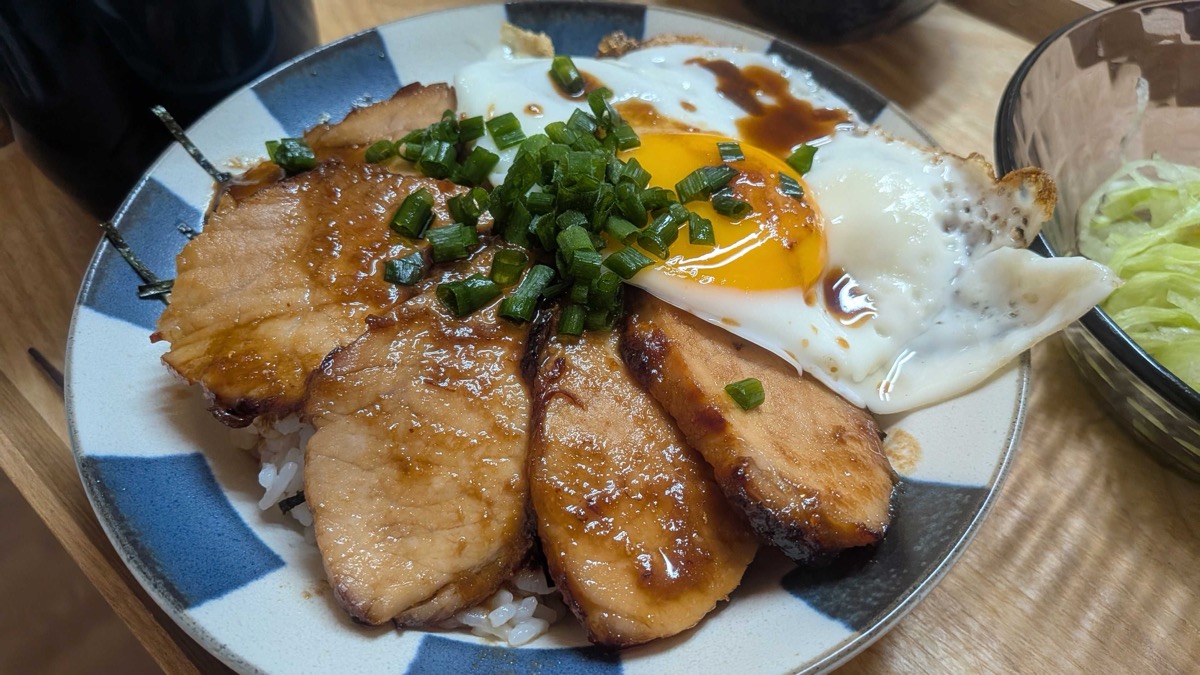
Chashu don is what happens to leftover chashu in a Japanese house. You slice it, lay it over hot rice, fry an egg, and chop some green onion over the top. It takes about four minutes once the pork exists, and in our house it is the Sunday lunch my wife asks for by name.
The pork here is not the ramen-shop kind. I already have a pork belly chashu recipe made in a pressure cooker, which is the right thing for ramen — fatty, soft, braised for an hour. This one is a pork loin block cooked in the air fryer, marinated overnight, browned hard until the center hits 75 °C, then held at 75 °C for an hour. It slices into neat lean rounds with a dark glazed edge, and it is much better on rice than pork belly is.
Disclosure: some links below are affiliate links. As an Amazon Associate I earn from qualifying purchases, at no extra cost to you.

Why You’ll Love This Recipe
- No pot, no braising liquid, no watching it. The marinade goes in a bag, the pork goes in the air fryer, and the machine does the rest.
- Lean pork that isn’t dry. Browning first and then holding at 75 °C is what keeps a cheap loin block juicy.
- The marinade becomes the sauce. Boil it down for two minutes and you have the glossy dark tare you see on the rice.
- One block feeds several meals. Rice bowl on day one, ramen topping and sandwich filling after that.
What is Chashu Don?
Chashu don (チャーシュー丼) is simply chashu on rice. Don is short for donburi, the word for both the deep bowl and the whole category of Japanese rice bowls — yakiniku don, katsudon, gyudon, oyakodon. Ramen shops sell a small chashu don as a side to order with your noodles, usually made from the offcuts and end pieces that can’t be sliced neatly enough to float on a bowl of ramen.
Chashu itself (叉焼) borrows its name and characters from Cantonese char siu, but the Japanese version went its own way a long time ago. Char siu is skewered and roasted over fire with a red-tinted honey glaze. Japanese chashu is usually braised or roasted in a soy, sake, mirin and sugar marinade, with garlic and ginger, and comes out brown rather than red. The “why is chashu red?” question you see online is about the Chinese dish, not this one.
Why Pork Loin Instead of Pork Belly
Ramen chashu is normally pork belly, rolled and tied, because the fat melts into the soup. On rice, that same fat is a lot — three slices of belly and a fried egg is a heavy lunch even by my standards.
A pork loin block (ロース, rosu) has a thin fat cap and lean meat underneath. Cooked properly it stays pale pink in the middle and tastes like roast pork rather than braised fat, which is exactly what you want against rice, soy tare and a runny yolk. It’s also cheaper per gram than belly at my local supermarket in Kyushu, which is not nothing.
Ingredients (Serves 2 to 3)
| Ingredient | Amount | Notes |
|---|---|---|
| Pork loin block | 300 g / about 10 oz | One supermarket block, untied |
| Soy sauce | 2 tsp | |
| Sake | 1 tbsp | Cooking sake is fine |
| Mirin | 1 tbsp | |
| Sugar | 1 tbsp | |
| Garlic paste | 1/2 tsp | The tube kind |
| Ginger paste | 1/2 tsp | The tube kind |
| Salt | 1/4 tsp | |
| Hot cooked rice | 2 to 3 bowls | Japanese short-grain |
| Eggs | 1 per bowl | Fried, yolk soft |
| Green onion | 2 to 3 stalks | Finely chopped |
| Shredded nori | A pinch per bowl | Optional |
The marinade is four pantry bottles and two tubes. If you’re building a Japanese shelf from scratch, the ones doing real work here are Japanese soy sauce and mirin on Amazon — the mirin is what gives the finished glaze its shine, and sugar alone won’t do it. Both turn up in most of my Japanese pantry essentials.
I scaled this down from a 500 g recipe to the 300 g block my supermarket sells. If you buy a bigger piece, scale the marinade with it — the cooking times below stay roughly the same for anything up to about 500 g, but check the temperature rather than the clock.
How to Make Chashu Don
Step 1: Mix the Marinade in a Bag
Put the soy sauce, sake, mirin, sugar, garlic paste, ginger paste and salt into a freezer bag and squash it around until the sugar dissolves.

A bag rather than a bowl matters more than it sounds. There is very little liquid here for a 300 g block, and in a bowl most of it would sit under the meat doing nothing. Pressed flat in a bag, that small amount touches every surface.
Step 2: Marinate Overnight
Add the pork, push the air out of the bag, tie it off, and refrigerate overnight — eight hours or more. Turn it once if you happen to walk past.

I stand the bag on a small steel tray in the fridge, partly because bags leak and partly because it makes the block easy to find. Don’t throw the marinade away when you take the pork out — it becomes the sauce in Step 6.
Take the pork out of the fridge about 30 minutes before cooking. A block straight from the fridge cooks unevenly, and with lean meat that gap shows.
Step 3: Brown It at 190 °C for About 13 Minutes
Preheat the air fryer, lift the pork out of the bag, let the excess marinade drip off, and put it in the basket. Cook at 190 °C (375 °F) for about 13 minutes. Mine was a 300 g block and 13 minutes was right; a thicker piece will need a few minutes more.

This is the browning stage and it’s the part that needs watching. The marinade is sugary, so the surface goes from brown to black faster than you expect. Look at it around the 7 to 10 minute mark, and if the top is already dark, tent a piece of aluminum foil over it for the rest of the time.
I use a COSORI TurboBlaze air fryer, which goes from 90 °F up to 450 °F. The low end is the reason this recipe works at all — most air fryers won’t go anywhere near the temperature needed for the next step. It’s the same machine I use for salt and pepper chicken wings and yaki onigiri.
Step 4: Check the Center for 75 °C
As soon as the high-heat stage finishes, push a probe thermometer into the thickest part of the block. You want 75 °C (167 °F) in the center. I use a basic Tanita digital probe like the one below — in the photo it’s just sitting on the counter showing room temperature — and when I checked the pork right after the drawer came out, it read 75 °C.

Please don’t skip this. Japan’s official guidance for home cooking is 75 °C held for one minute, and block thickness varies far more than weight suggests, so a cheap probe thermometer is the only way to know you’re there. If it reads low, give it a few more minutes at 190 °C — foil on top so the glaze doesn’t burn — and check again. Once the center is at 75 °C, the next hour keeps it there.
Step 5: Hold at 75 °C for 60 Minutes, Then Rest
Now switch to the dehydrate setting — on mine it’s labeled dry — and run it at 75 °C (167 °F) for 60 minutes. Leave the pork where it is and don’t open the drawer.

This is the whole trick. Hot and fast gives you color, but keep going at high heat and a lean loin squeezes itself dry; low and slow on its own gives you juicy meat with a gray exterior. Browning first and then an hour at 75 °C gets both. The drawer is set to the same temperature as the center, so the pork stays safely hot without cooking any further, and the juices settle back through the meat — which is why the slices in the photos are still pale pink and wet.

Rest the block on a board for 10 minutes before slicing.

Step 6: Boil the Marinade Down Into Tare
Pour the leftover marinade from the bag into a small pan and simmer it for 2 to 3 minutes, until it thickens slightly and coats the back of a spoon.
It has to actually boil. This liquid sat overnight with raw pork in it, so a proper simmer is not optional — it’s what makes it safe to spoon over rice. Boiling also cooks off the alcohol in the sake and mirin and concentrates the sugar into the dark, glossy tare you can see on the finished bowls.
Step 7: Slice and Build the Bowl
Slice the chashu as thin as you can manage, across the grain.

Then build it in this order:
- Hot rice in a shallow bowl, with a pinch of shredded nori over it.
- Chashu slices fanned across the rice, overlapping.
- A fried egg on one side, yolk still soft.
- A heap of chopped green onion in the middle.
- The tare spooned over the pork and around the egg white.

Break the yolk before the first bite, not after. It runs into the rice and the tare and makes the sauce.
Tips and Variations
- Foil is your friend at 190 °C. Sugary marinade burns. Tent the top if it darkens before the time is up.
- Trust the thermometer, not the timer. Block thickness varies far more than weight suggests. Check for 75 °C in the center right after the high-heat stage.
- Chill it before slicing for ramen. Cold chashu slices much thinner than warm chashu. For a rice bowl, warm and thick is better.
- Add a soft-boiled egg instead of a fried one if you want the ramen-shop version. Marinate it in a little of the tare thinned with water.
- No air fryer? A 190 °C oven for 15 minutes, then 80 °C for an hour, does roughly the same thing. My pressure cooker chashu is the other route entirely.
- Double the marinade and keep the tare. It’s good on plain rice, on yaki onigiri, or stirred into fried rice.
What to Serve It With
A chashu don is rich and salty and all one texture, so everything around it should be cold, crunchy or sour. The night I took these photos we had it with shredded lettuce and two small side dishes from the fridge.
 Save
Save- Plain shredded lettuce in a glass bowl. No dressing needed — the tare from the bowl does the job.
- Kiriboshi daikon, the black bowl in the photo at the top of this post. It keeps for days and is the standard fridge side dish in Japanese houses.
- Miso soup, if you want to make it a proper meal rather than a Sunday lunch.
- Edamame or another cold green thing, especially in summer.
Storing and Reheating
Keep the block whole and unsliced — it dries out much faster in slices. Wrapped tightly or sealed in a bag with a spoonful of the boiled tare, it keeps in the fridge for 3 to 4 days. Slice off what you need each time.
Sliced chashu freezes well for about a month. Lay the slices flat in a bag with a little tare so they don’t stick together, and thaw them in the fridge overnight.
For reheating, don’t microwave lean pork hard — 20 seconds at half power is plenty, and anything more turns it tough. Honestly the better answer is not to reheat it at all: lay cold slices on hot rice, or drop them into a bowl of hot ramen and let the soup do the work.

Frequently Asked Questions
What is chashu don?
Sliced Japanese chashu pork served over a bowl of hot rice, usually with green onion, a soy-based tare, and often an egg. Don is short for donburi, the Japanese word for a rice bowl dish. Ramen shops sell small ones as a side order alongside noodles.
What is chashu made of?
Pork — belly for ramen toppings, loin or shoulder for eating on rice — marinated in soy sauce, sake, mirin and sugar with garlic and ginger, then braised or roasted. Japanese chashu is brown, not the red of Cantonese char siu, because it uses no red coloring or honey glaze.
Can you make chashu in an air fryer?
Yes, and for a lean loin block it’s better than braising. Brown it at 190 °C for about 13 minutes until the center reads 75 °C, then hold it at 75 °C for an hour on the dehydrate setting. You need an air fryer that goes low enough for that second stage — many start at 80 °C or higher.
What temperature should chashu be cooked to?
75 °C (167 °F) in the center, held for a minute — that’s Japan’s standard home-cooking guidance for pork. Check it with a probe thermometer in the thickest part rather than relying on the timer, because block thickness varies.
Can you reuse the chashu marinade?
Only after boiling it. Simmer the used marinade for 2 to 3 minutes and it becomes the tare you spoon over the rice. Never use it unheated — it held raw pork overnight.
How long does homemade chashu keep?
3 to 4 days in the fridge if you keep the block whole and sealed with a little of the tare, or about a month sliced and frozen flat in a bag.
Chashu Don (Air Fryer Japanese Pork Rice Bowl)
Ingredients
Method
- Put the soy sauce, sake, mirin, sugar, garlic paste, ginger paste and salt in a freezer bag and squash it around until the sugar dissolves. A bag works better than a bowl here: there is very little liquid, and pressed flat it touches every surface of the meat.
- Add the pork, push the air out, seal the bag and refrigerate overnight (8 hours or more), turning it once if you can. Keep the marinade when you take the pork out – it becomes the sauce.
- Take the pork out of the fridge about 30 minutes before cooking. Lift it out of the bag and let the excess marinade drip off.
- Preheat the air fryer and cook the pork at 190C / 375F for about 13 minutes to brown it (13 minutes for a 300 g block; a thicker piece needs a few minutes more). The marinade is sugary and burns easily, so check at 7 to 10 minutes and tent a piece of aluminum foil over the top if it is already dark.
- As soon as the high-heat stage finishes, push a probe thermometer into the thickest part of the block. It must read 75C / 167F in the center. If it reads low, give it a few more minutes at 190C with foil on top and check again.
- Switch to the dehydrate or dry setting and hold at 75C / 167F for 60 minutes. Do not open the drawer. The pork stays safely at temperature without cooking further, which is what keeps a lean loin juicy. Rest the block on a board for 10 minutes.
- Pour the leftover marinade into a small pan and simmer for 2 to 3 minutes until it thickens slightly. It must actually boil – it held raw pork overnight.
- Slice the chashu thin across the grain. Build each bowl: hot rice, a pinch of shredded nori, the chashu slices fanned over the rice, a fried egg with a soft yolk, a heap of chopped green onion, and the tare spooned over the top.


